
Guide to Injection Molding Surface Finishes: SPI, VDI & Mold-Tech


Why We Need Surface Finish
Most injection molds are machined from aluminum or steel. If left completely untreated, the cutting paths and tiny machining marks left behind by the factory's CNC end mills will transfer directly onto your raw plastic parts.
While leaving these tool marks raw is perfectly fine for hidden, non-visible internal features, any surface that an end-user can see or touch requires deliberate surface preparation to look professional.

What Are the Benefits?
Selecting the right surface treatment achieves several critical design and manufacturing goals:
- Boosts Aesthetic Appeal: Smooth or matte textures elevate a product's premium feel while instantly hiding minor molding flaws like flow lines, knit lines, and sink marks.
- Improves Functional Performance: Texturing creates a more tactile grip and significantly improves how cleanly paints, labels, or adhesive stickers bond to the plastic.
- Aids Mechanical Molding: Properly designed textures help trapped molding gases escape cleanly, reducing common molding defects like short shots or flash.
Types of Surface Finish
When specifying your design intent on a drawing, surface finishes fundamentally split into three legs based on whether you need smoothness, controlled roughness, or an organic pattern:
1. SPI Standards (The "Smooth & Glossy" Texture)
- What it is: A system based on progressive manual polishing, scaling from rough stone sanding up to diamond-buffed mirror polishes.
- Best used for: Optical lenses, clear transparent windows, and high-gloss "piano black" consumer housings.
- The Scale: Ranges from A-1 (pure optical reflection) down to D-3 (coarse blast).
- Cost Mid-Range: SPI The cost scales heavily with the grade. While a low-polish stone finish (SPI C-1) is very cost-effective and cheap, high-gloss mirror polishes (SPI A-1) require intensive, highly skilled manual bench time to hand-buff the steel with diamond pastes, driving up tool costs.

A1–A3 (Gloss): Diamond-buffed mirror polish for optical lenses.
B1–B3 (Semi-Gloss): Paper finish for visible housings.
C1–C3 (Matte): Stone-sanded finish for hidden internal parts.
D1–D3 (Texture): Blasted anti-glare finish for industrial grips.
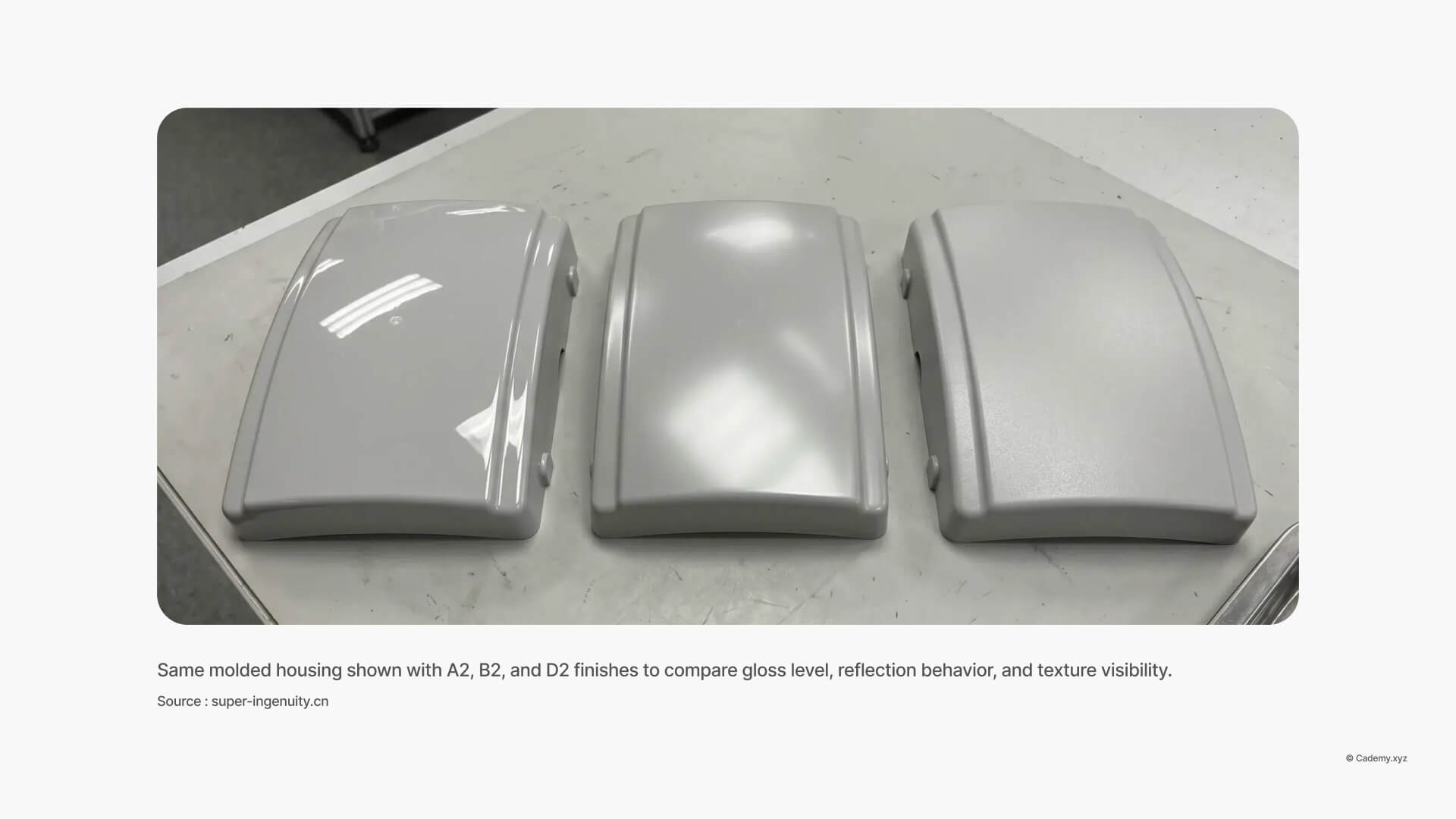
2. VDI 3400 Standards (The "Cost-Effective Matte" Texture)
- What it is: A European texturing system (Verein Deutscher Ingenieure) formed directly by Electrical Discharge Machining (EDM) machine sparks cutting into the tool steel.
- Best used for: Standard non-reflective matte housings, industrial enclosures, and anti-glare panels.
- The Scale: Ranges from VDI 12 (smoothest matte) up to VDI 45 (rough, sandpaper-like texture).
- Cost Cheapest: VDI 3400 requires virtually no manual labor. The matte texture is spark-eroded directly onto the mold steel by the EDM machine during the tool cutting process itself.

To achieve specific VDI surface finishes, the EDM process is controlled in the following ways:
- Spark Energy: Higher spark energy removes more metal, creating deeper craters and a higher VDI number (rougher texture). Smaller spark gaps generate finer, misty finishes.
- Electrode Material: The texture is initially shaped into a graphite or copper electrode. The electrode geometry and its own microscopic surface profile help dictate how the spark erodes the base metal.
- Dielectric Fluid: The entire process is submerged in dielectric oil or water, which acts as a coolant and flushes away the molten metal particles. The flushing rate helps clean the craters properly to maintain a uniform texture.

3. Mold-Tech (Standex) & Yick Sang (The "Premium Pattern" Texture)
- What it is: Proprietary, private design libraries applied to the mold using precision 5-axis lasers or chemical etching.
- Best used for: Complex, consumer-facing organic textures that simple machinery cannot describe, such as faux leather grain, wood textures, or carbon fiber weaves.
- Cost Most Expensive: Proprietary Mold-Tech / Yick Sang — These carry premium upfront costs. The toolmaker must completely finish the mold, shield it, and ship it to a specialized facility to apply complex textures using expensive chemical etching or precision 5-axis lasers. Additionally, you must pay licensing fees to use their proprietary pattern libraries.

How Mold-Tech (Standex) Chemical/Laser Etching Works
- Apply the Photoresist: The finished tool steel mold cavity is coated with a liquid photoresist (a light-sensitive chemical).
- Project the Pattern: The desired texture pattern is projected onto the coated steel using ultraviolet (UV) light or Laser. The UV rays cure and harden the chemical mask onto the mold where the texture lines should remain untouched.
- Acid Bath Etching: The mold is bathed in a specialized acid solution. The exposed steel that was not protected by the cured chemical mask is etched away by the acid, creating the final, permanent textured pattern.

Things to Keep in Mind When Selecting a Finish
Before locking down your finish code on a drawing, keep these critical engineering trade-offs in mind:
- VDI Has a Smoothness Ceiling: The smoothest possible VDI grade is VDI 12, which only equates to a low-polish SPI C-1 stone finish. You cannot achieve a high-gloss mirror finish using VDI codes; those require manual diamond buffing.
- Gloss Amplifies Imperfections: Mirror-polished surfaces (SPI A-Grade) act as visual amplifiers. Minor internal molding defects like flow lines or micro-sink marks will stand out glaringly on a glossy surface.
- The "Draft Angle Tax": Textured surfaces create thousands of microscopic undercuts that grab onto the mold. Heavy VDI or Mold-Tech grains easily require higher draft angle to avoid dragging and scuffing during ejection.
- Material & Steel Limits: High-gloss finishes require clean, premium tool steels (like S136 or 420ESR) to prevent surface pitting. Additionally, abrasive materials like glass-filled nylon will quickly wear away fine diamond polishes over production lifetimes.


